ITBP Head Constable Motor Mechanic Syllabus 2026
ITBP Head Constable Motor Mechanic syllabus: 100 marks in 2 hours at 12th standard, with 60 marks of trade theory, then a qualifying skill test.
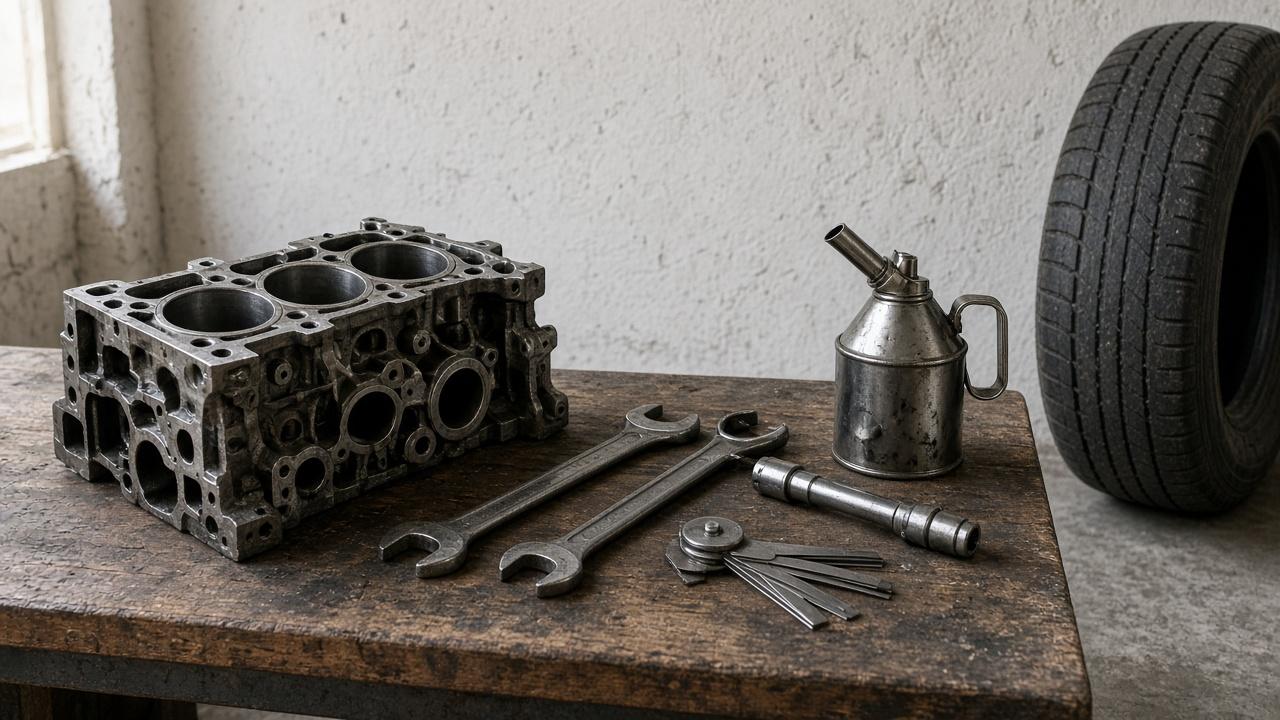
The Head Constable (Motor Mechanic) selection has two tests that look like exams and only one that decides the rank. The written paper is 100 marks. The practical test is 50 marks and has to be passed, and it is then set aside. Age, the ITI or diploma rule, and the fee are on the recruitment page.
The notice says the questions are of 12th standard. It does not publish a chapter-wise trade syllabus or a previous paper. The trade map below is the workshop theory a 12th-standard motor-mechanic paper in India actually asks. If ITBP later uploads a topic list, that list replaces this map.
Written paper
You reach this paper only after the physical tests and after the original certificates have been accepted. A candidate who fails documentation is not given this admit card. The paper may be on a computer or on OMR. ITBP decides. Phones, calculators, paper and digital wristwatches are barred, switched on or not.
| Subject | Questions | Marks | Time |
|---|---|---|---|
| General knowledge, bilingual | 10 | 10 | 2 hours for the whole paper |
| Mathematics, bilingual | 10 | 10 | |
| Hindi or English | 20 | 20 | |
| Trade-related theory, bilingual | 60 | 60 | |
| Total | 100 | 100 |
The language line is the one aggregators flatten. The notice says there are 20 Hindi questions and 20 English questions, and the candidate attempts 20 in either language. You do not answer 40 language questions. Choose the language you write accurately under a clock, and skip the other set. Twenty marks is a fifth of the paper. A careless language choice is a larger loss than a missed current-affairs item.
Qualifying marks are 35 percent for General, EWS and ex-servicemen, and 33 percent for SC and OBC (NCL). The notice does not print negative marking. It also does not print a sentence that says marking is absent, which the counsellor notice does. Until ITBP says otherwise, do not assume a penalty, and do not assume a bonus. Answer what you can finish cleanly.
A wrong or damaged booklet can be changed if you ask within 10 minutes of the start. After that, the booklet you have is the booklet you finish. Copying ends the test and is marked on the answer sheet.
Two hours for 100 questions is 72 seconds each. Trade is 60 marks, so it should get about 70 minutes. Language gets about 25 minutes. Mathematics and general knowledge share the rest. A trade calculation that needs a long derivation is a trap at this speed. Most items are one fact or one short sum.
Trade theory, 60 marks
Revise as a mechanic explains a fault to a trainee, in this order.
Engine. Four-stroke cycle: intake, compression, power, exhaust, two revolutions of the crankshaft. Petrol engines ignite with a spark. Diesel engines ignite by the heat of compressed air. A glow plug is a cold-start aid, not the normal ignition. The camshaft opens the valves. The crankshaft turns reciprocating motion into rotation. The flywheel smooths the power strokes. Firing order is the sequence of power strokes. Remember what the term means, and read the order stamped for the engine in front of you during the skill test. Do not force one model's order onto another.
Fuel and air. A petrol carburettor or an injector meters fuel. A diesel injector sprays into hot air. Black smoke on a diesel is excess fuel or starved air: dirty air filter, bad injector, overload. White smoke on a cold diesel can be unburnt fuel. Blue smoke is oil burning. The air filter, the fuel filter and water in the diesel are everyday fault questions.
Lubrication and cooling. Oil reduces friction and carries some heat. SAE grades such as 20W-40 describe viscosity when cold and when hot. The oil pump, the filter and the pressure warning light are the system. Coolant, not oil, is what the radiator is for. The pump circulates it, the thermostat holds the engine at working temperature, and a collapsed hose or a low level shows up as overheating. Mixing an unknown coolant with the one already in the engine is a fault you should be able to name.
Transmission. The clutch disconnects the engine from the gearbox so a gear can be selected. Slip, drag and judder are the three clutch complaints. The gearbox gives torque and speed ranges. The propeller shaft takes the drive to the rear on a front-engine, rear-drive vehicle. The differential lets the outer wheel turn faster in a corner. A universal joint allows the shaft angle to change as the axle moves.
Brakes and steering. Hydraulic brakes use an almost incompressible fluid. Air in the line makes a spongy pedal, and the cure is bleeding. Drum brakes and disc brakes both convert motion into heat. The handbrake is usually a cable on the rear. ABS stops the wheel locking so the tyre can still steer. Toe, camber and castor are three different angles. Toe is in the plan view. Camber is the inward or outward tilt seen from the front. Castor is the fore-and-aft tilt of the steering axis. A paper that says "all of these are the same" is wrong.
Electrical. The battery is lead plates in dilute sulphuric acid. The alternator charges it while the engine runs. The starter motor only cranks. A fuse protects a circuit. A multimeter reads volts, amps and ohms. Earthing a live wire to "test" it is how harnesses burn. Colour blindness is already a medical bar, and the electrical questions still expect you to know that wiring is identified by a code, not only by memory of one colour.
Tools and measurement. A feeler gauge measures a small gap: valve clearance, spark-plug gap, points. A torque wrench tightens to a specified force. A vernier or a micrometer measures a diameter. Guessing wheel-nut torque, or using a hammer on a thread, is the handling-of-tools mark waiting to be lost in the practical. Tyre pressure is checked cold. A tyre worn in the centre was over-inflated. Wear on both edges suggests under-inflation. Wear on one edge suggests alignment.
Workshop safety. Jack stands under a raised vehicle, a battery disconnected before welding near it, fuel kept off a hot manifold, and a fire extinguisher rated for fuel and electrical fires. These are short items and they are also what the examiner watches in the skill test.
The practice questions stay inside this map.
Language, mathematics and general knowledge
Mathematics is 10 marks at 12th standard and the notice calls the reasoning on the other ITBP paper "simple". For this paper, revise percentage, ratio, average, time and work, time and distance, LCM, and a short profit-and-loss item. Show the unit. A speed asked in km/h and supplied in metres needs one conversion, not a new formula.
General knowledge is 10 bilingual questions. The force, the border, a few Articles of the Constitution, and a recent national fact you can date are enough. Do not buy a current-affairs course for 10 marks and skip diesel combustion.
Language is 20 marks in the language you choose. Hindi: पर्याय, विलोम, वर्तनी, मुहावरा and a clean sentence. English: synonym, spelling, tense, preposition. Workshop words in both languages are worth a evening: क्लच, ब्रेक, इंजन, औजार, and clutch, brake, torque, clearance.
Skill test
Ten times the vacancies in each category are called, using the written marks. The test is 50 marks.
| Part | Marks |
|---|---|
| Vehicle inspection | 10 |
| Identification of faults | 10 |
| Rectification of defects | 25 |
| Handling of tools | 5 |
Every category needs 50 percent, which is 25 marks out of 50. The test is qualifying. A candidate who scores 49 out of 50 and a candidate who scores 25 out of 50 are equal after this stage, if both have the same written score. The extra practical marks do not move the merit. A candidate below 25 is out, however high the written score was.
Rectification is half the practical. That is the job: find the defect and put it right, with the right tool, without damaging the thread or the finish. Inspection is looking in an order, not poking at random. Identification is naming the fault from the symptom. Handling of tools is whether the spanner, the torque wrench and the feeler gauge are used as they are designed.
Ex-servicemen do not take the physical efficiency test. They do take this skill test.
Merit
The list is category-wise and uses written marks. UR, SC, OBC (NCL), EWS and ex-servicemen are listed. An SC, OBC or EWS candidate selected without a relaxed standard goes to the unreserved vacancy. An empty ex-serviceman vacancy is filled from the non-ex-serviceman list of that category. There is no reserve list. The same written marks go to the older candidate, then to the earlier name in the English alphabet.
The medical examination is after this merit. It can remove a candidate. It cannot add a mark. Read the height and chest table on the recruitment page before the physical day, because a failed measurement ends the process before any of this paper is seen.
A revision week that matches the marks
Five evenings is enough if each evening has one system and a few sums. A stack of unread PDFs is not a week.
Day one is the engine and the fuel. Four strokes in order. Spark versus compression ignition. What black, blue and white smoke suggest. Write the answers, do not highlight them.
Day two is lubrication, cooling and the clutch. Which fluid goes in which reservoir. What a spongy brake pedal means, and why that symptom is not an oil problem. SAE grade versus DOT grade.
Day three is the rest of the drive and the steering geometry. Gearbox, propeller shaft, differential, toe, camber, castor. One sentence each, then a sketch.
Day four is electrical and measuring tools. Battery, starter, alternator, fuse, feeler gauge, torque wrench, tyre wear. This is also the evening you decide Hindi or English for the 20 language marks and do twenty items in that language only.
Day five is ten mathematics items and ten general-knowledge items, then a timed 20-question trade set. The questions on the practice page are for that last evening. The systems you miss become day six. The systems you know do not need another full reading.
Keep the experience certificate and the 10+2 paper in the same folder as this revision. Documentation is before the written exam. A perfect trade score is unavailable to a candidate who does not reach the paper.
Frequently Asked Questions
100 questions, 100 marks, 2 hours, at 12th standard. General knowledge 10, mathematics 10, Hindi or English 20, trade theory 60.
No. There are 20 questions in Hindi and 20 in English, and you attempt 20 in one language.
It is qualifying. The pass mark is 50 percent of 50. The merit list is the written score.