ITBP Head Constable Motor Mechanic Question Paper 2026
Original trade-theory practice for the ITBP Head Constable Motor Mechanic written paper, at 12th standard and at the pace of the 2-hour test.
The written paper is 100 questions in 2 hours, with 60 marks of trade theory. The full pattern, including the language choice and the skill test, is on the syllabus page. This sitting is 20 questions in 24 minutes. Sixteen are trade. Four are the short mathematics the paper also carries. That is the same 72 seconds a question as the hall.
ITBP has not published a previous paper. Learn the pairs below before you start the clock. They are the items a 12th-standard paper uses to separate someone who has worked on a vehicle from someone who has only read the names.
How this sitting is set
The notice does not print negative marking for this post. It also does not print the clear "no negative marking" line that the Education and Stress Counsellor notice uses. Practise for accuracy. On the real paper, answer the questions you can finish, and do not invent a penalty the notice has not given you.
Qualifying marks are 35 percent for General, EWS and ex-servicemen, and 33 percent for SC and OBC (NCL). The skill test later needs 25 out of 50 and then drops out of the ranking. A high score on this written practice is what moves the merit. A beautiful practical, below the written cut-off, never gets called.
Faults worth learning as pairs
Spark and compression. A petrol engine needs a spark plug because the compression ratio is not high enough to ignite the mixture by heat alone. A diesel engine is built for that heat. If a question says "ignites the diesel", the answer is compressed air, not a spark plug. A glow plug helps a cold start. It is not the running ignition.
Camshaft and crankshaft. The camshaft opens the valves. The crankshaft takes the piston's up-and-down movement and turns it into rotation. The flywheel keeps that rotation from pulsing. Candidates swap camshaft and crankshaft because both are shafts in the same picture.
Clutch and differential. The clutch is about connecting and disconnecting the engine and the gearbox. The differential is about two driving wheels that must turn at different speeds in a corner, because the outer wheel travels farther. A question about "selecting a gear" is the clutch. A question about "the outer wheel" is the differential.
Brake fluid and engine oil. Brake fluid carries pressure because it hardly compresses. Air in that line is why the pedal feels soft, and bleeding removes the air. Engine oil is for the bearings and the cylinder walls. Power steering fluid, coolant and brake fluid are not substitutes for each other. Pouring one into the other's reservoir is a fault you should be able to refuse out loud in the skill test.
Alternator and starter. The alternator charges the battery while the engine runs. The starter motor uses the battery to crank the engine, and then its job is over. A flat battery after a long run points at the charging circuit. A click and no crank points at the battery or the starter. The symptom tells you which one the question wants.
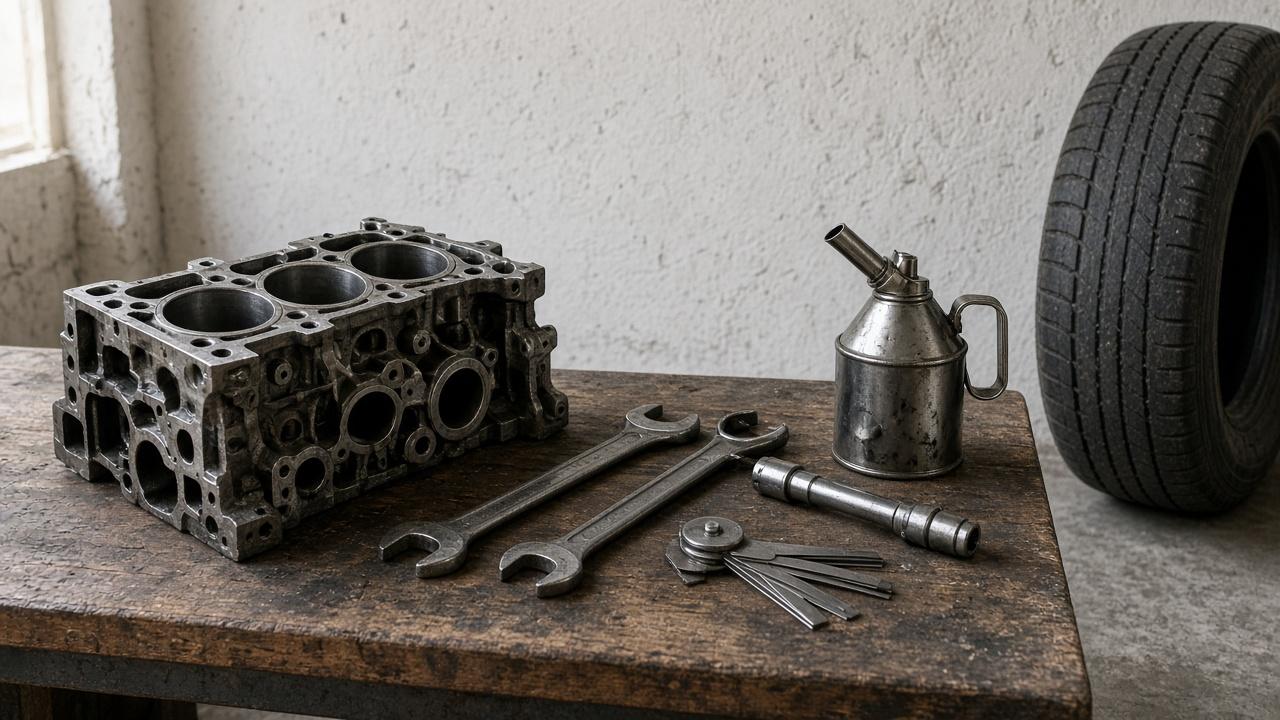
Feeler gauge and torque wrench. The feeler gauge is a stack of blades of known thickness, for a gap: valves, plugs, points. The torque wrench stops you at a specified tightness. Wheel nuts, head bolts and bearing caps have a figure. "Tight enough" is how threads strip. In the practical, handling of tools is only 5 marks, and rectification is 25. Using the wrong tool loses both.
Toe, camber, castor. Toe is seen from above: the fronts of the wheels closer together is toe-in. Camber is seen from the front: the inward or outward tilt of the wheel. Castor is the tilt of the steering axis toward the front or the back, and it is what helps the wheel return after a turn. One sentence each is enough. A question that offers all three as names for the same angle is wrong.
Smoke. Black smoke from a diesel is fuel that did not find enough air, or an injector that is over-fuelling. Blue smoke is oil. A battery fault does not make black smoke. When you read a symptom, throw out the option from a different system before you pick.
Tyre wear, in one line. Centre wear: too much pressure. Both shoulders: too little pressure. One shoulder: alignment. Check pressure cold.
A firing order is the sequence of cylinders on the power stroke. Inline-four engines are often 1-3-4-2, and that number is not a law of nature. In the hall, if the question asks for a specific engine's order and you do not know that engine, do not borrow a number from a different model. In the workshop, read the manual for the vehicle on the ramp.
Mathematics on this paper is short. Fifteen percent is ten percent plus half of that. Speed is distance divided by time, in one unit. The LCM of 4, 6 and 8 is 24, and you can check by dividing. Time and work: if three men finish in six days, the job is 18 man-days, so one man does one eighteenth in a day.
After the set, list the pairs you missed and revise only those. The trade block is 60 marks. Spending the next week on general knowledge, which is 10 marks, will not repair a missed diesel question.
One evening in the workshop of your head
You do not need a vehicle under your hands to revise the written paper. You need the systems in the order a fault appears.
Start the engine in your mind. Intake, compression, power, exhaust. Say which shaft opens the valves and which shaft the piston turns. Say why a diesel has no spark plug in normal running, and what a glow plug is for. If you hesitate, that is the page to reread, not the general-knowledge booklet.
Move to the fluids and keep them in different bottles. Engine oil lubricates. Coolant carries heat to the radiator. Brake fluid carries pressure. Diesel is the fuel. Mixing the bottles is both an exam option and a mistake that ruins a master cylinder or a bearing. SAE 20W-40 is an oil grade. DOT is a brake-fluid grade. A question that calls 20W-40 a brake fluid is testing whether you glanced at the label or understood it.
Then the drive. Clutch pedal down, engine free of the gearbox, gear selected, pedal up. In a corner the outer wheel has a longer path, so the differential lets it spin faster. If you can sketch that with a finger on the table, the 60-mark block has started to sit in the right order.
Brakes next. Pedal, fluid, no air, shoes or pads, heat. ABS releases a wheel that is about to lock so you can still steer. A locked wheel slides in a straight line. That one sentence answers more than one "what is ABS" item.
Electrical in four parts: battery, starter, alternator, fuse. The starter is a short, heavy job. The alternator is the whole journey. A fuse is a deliberate weak point that saves the wire.
Tools last, because the skill test will watch your hands even though those marks do not enter the merit. Feeler gauge for a gap. Torque wrench for a figure in the manual. You do not tighten a head bolt "until it feels right", and you do not measure a valve clearance with a steel rule.
Language is a separate decision you make once, before the exam, not in the first minute. If your Hindi spelling is cleaner than your English, take the Hindi set of 20 and do not wander into the English set. The notice gives you one language, not both. Twenty marks is the difference between 33 and a comfortable pass, or between a pass and a miss, depending on the trade score.
When the 24 minutes below are over, mark the system you lost: engine, fuel, oil and coolant, transmission, brakes, electrical, or tools. Revise that system only. The trade paper is wide, and a second pass through the system you already know does not pick up the marks you dropped.
Where the written score actually goes
Qualifying is 35 marks for General, EWS and ex-servicemen, and 33 for SC and OBC (NCL). The skill test is a later gate of 25 out of 50, and it does not add to the rank. Two candidates with the same written mark stay tied on age, then on the English alphabet, no matter who repaired the fault faster in the practical.
That changes how you spend the week. A working mechanic can be confident in the bay and still drop the 20 language marks and the 10 mathematics marks. Those 30 marks are easier to lose on paper than on a vehicle. A clean percentage, a correct LCM, and twenty items in the one language you chose are the gap between a qualifying mark and a rank that survives the shortlist.
The shortlist is concrete. The notice calls ten times the category-wise vacancies. Seven posts means about 70 names, in written-mark order. The next written score is not called, however good the hands are. Inside the called list, anyone under 25 out of 50 on the practical is removed. The rest are ranked by the written score they already hold. Extra practical marks do not pass a candidate who wrote a weaker paper.
This 24-minute set is the rank. The pairs at the top of the page are what keep the practical from eliminating you later. If one trade question eats four minutes, mark the answer you can defend and move. The budget is 72 seconds. You can return in the last two minutes if the clock is still running.
Practice
Loading the practice paper.
Frequently Asked Questions
No. The 2026 notice does not include a previous paper. These are original questions at the 12th-standard trade level the notice names.
On the real selection, the skill test is qualifying at 50 percent. Merit is the written score. This practice covers the written trade questions, not the practical marking.
On the real paper you choose one language for the 20 language marks. This practice uses the trade and mathematics marks, which are the larger part of the paper.